Prices in August 2026 were 3.4% higher than a year earlier. Gasoline was up 27.4%. Airline fares, 23.4%. Fuel oil, 52%. Social Security raised benefits 2.8% for the year, which is less than 3.4%, so a fixed check quietly bought less in August than it did last August.
Shoppers leaned harder on sales this year, which is what you would expect. Retailers answered by discounting less.
The number that changed my mind
Prime Day is the cleanest annual read I know of on how retail discounts behave, because the same catalog gets tracked the same way three years running.
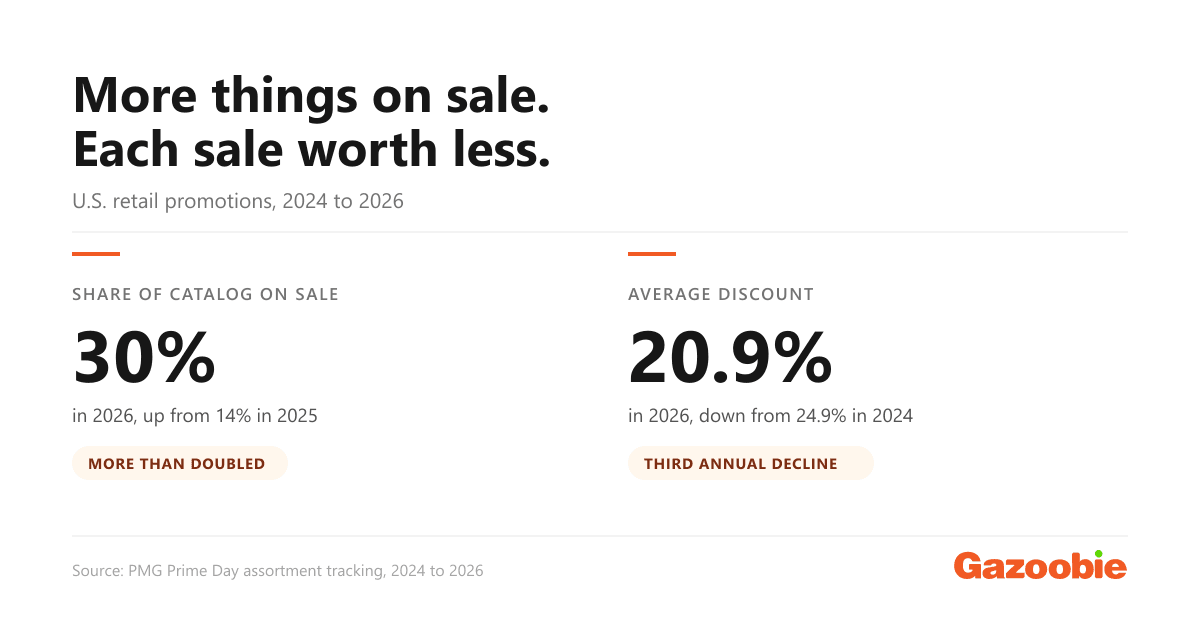
In 2025, roughly 14% of the tracked assortment carried a promotion. In 2026, that figure was roughly 30%. Promotional reach more than doubled in twelve months.
Over the same stretch, the average discount shrank. It was 24.9% in 2024, 21.8% in 2025, and 20.9% in 2026. The share of offers landing in the shallow 10% to 19% band climbed every year: 28.0%, then 32.2%, then 37.0%.
Put those together and you get the sentence that matters. Twice as many things wear a sale tag, and the tag is worth about a fifth less than it was two years ago.
Nobody is cheating here. It is a margin decision, and a defensible one. Tariffs, freight, and labor all moved. Retailers chose to spread thinner discounts across more of the shelf rather than cut deeper into fewer items. If I ran a merchandising team in 2026 I would probably do the same thing.
But it has a side effect nobody on the retail side has to live with.
The label stopped carrying information
A price tag does two jobs. It tells you what something costs, and it tells you whether now is a good time to buy.
The second job depends on scarcity. When one item in seven is marked down, "on sale" is a signal. When one item in three is marked down, it is wallpaper.
So the shopper inherits the work. Is 20% off good for this category, or is it the standing rate? Was that crossed-out price real last month? Is the thing itself any good, or is it discounted because nobody wanted it at full price? None of that is printed anywhere. You are expected to just know.
Multiply that by a household worth of purchases in a year where gas is up 27% and the budget has no slack. Saving money became a research job that pays nothing.
More deals is not the fix
Here is where the deal industry, ours included, has been unhelpful.
The standard response to an overwhelmed shopper has been volume. More coupons, more offers, more stores, refreshed hourly, sorted by whatever the affiliate feed happened to return. Most deal sites compete on catalog size. The pitch is usually some version of "we have the most."
That answers a question nobody asked. The shopper is not short on offers. They are short on judgment about which offers deserve their attention, and short on the time it takes to produce that judgment one purchase at a time.
What Gazoobie does instead
Gazoobie reads affiliate feeds the same way every deal site does, several hundred thousand live offers at a time. The difference is what happens next.
Each offer gets scored, and the great majority are thrown away. As of September 14, the AI had scored 77,278 offers. 2,503 cleared the bar and made the board. That is about 3 in 100. The other 97 are what every other deal site still shows you.
What survives gets one more thing attached: who it is for. A road tripper and a pet parent are not hurting in the same aisle this year. Gas up 27% and groceries up 2.2% are two completely different budget problems, and a deal that is excellent for one household is noise to the other. Sorting only by discount percentage hides that.
The product is what it leaves out. That is an uncomfortable thing to build, because the metric everyone else reports is the one we deliberately drive down.
What we will not claim
Two rules are published on this site, and we would rather state them here than have someone find the gap.
Gazoobie does not call any real store sale fake. The industry pattern above is worth discussing in the open. Accusing a named retailer is a different act, it is often wrong, and we are not doing it to win a headline.
Our own price record only started in August 2026. It is deep enough to show a price moving and nowhere near deep enough to support a record-low claim, so Gazoobie does not claim a lowest-ever price. When the record is long enough, we will. No data, no claim.
Those two rules cost real traffic. Both are staying.
The part we keep coming back to
Discount breadth doubling while discount depth falls is a story about a signal wearing out.
When a label stops meaning anything, somebody still has to do the sorting. For the last few years that somebody has been the shopper, unpaid, at eleven at night, with four tabs open.
That is the job we wanted to hand to a machine.
Looking for the deals, not the history?
Gazoobie's AI reads thousands of live offers and surfaces only the ones worth buying, each labelled with who it suits.
See the Real Deals boardQuestions people ask
Are retailers faking their sales?
That is not the question we answer, and we do not accuse named stores of it. What the tracked data shows is a strategy shift: more of the catalog carries a promotion and each promotion is shallower. That is a margin decision, not a trick. The practical effect on you is the same either way, which is that a sale tag no longer tells you much on its own.
Is 20% off a good discount now?
It is roughly average. The average tracked discount was 20.9% in 2026, and the most common band was 10% to 19% off, which covered 37.0% of offers. So 20% off sits in the middle of the market rather than standing out. Whether it is a good deal depends on the item and the category, not on the percentage alone.
Where do these numbers come from?
The inflation figures are from the U.S. Bureau of Labor Statistics Consumer Price Index release for August 2026. The promotional breadth and discount depth figures are from PMG assortment tracking across Prime Day 2024, 2025 and 2026. Both are linked at the end of this article. The curation figures are read from our own board.
Does Gazoobie track price history?
Yes, but only since August 2026 and only for the offers that state a price. That is deep enough to show a price moving and not deep enough to support a lowest-ever claim, so we do not make one. We would rather say what the record cannot do than imply it does more than it does.